

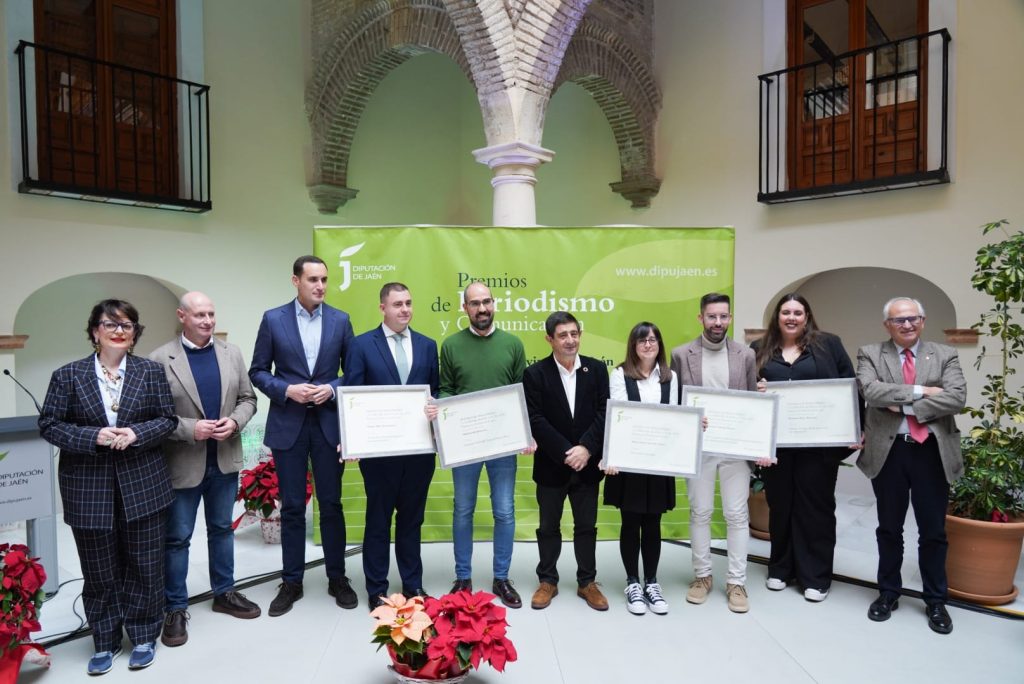
The Grupo Multimedia Jiennense received this Friday the 2025 Local Journalism and Communication Award, granted by the Diputación Provincial de Jaén to recognize the best works across various categories. The report directed by journalist Alfonso Fernández for the program Al Detalle on Diez Televisión won the award in the television category. The piece focuses on the remains of the Iberian civilization and the museum that will house them in the capital city of Jaén.
The president of the Diputación Provincial de Jaén, Francisco Reyes, encouraged media professionals to “keep practicing high-quality and close-to-home journalism” because it is what “interests citizens the most.”
Reyes made these remarks at the Baños Árabes Cultural Center in Jaén during the presentation of the awards. In this 2025 edition, the accolades also went to Elisabeth Ruiz, Tomás Díaz, Esther Garrido, and Antonio Cañada, in addition to Marta Curiel, who received a special mention.
During his speech, Reyes noted that the winners “personify the excellence of this noble and essential craft of journalists and photojournalists.” He added that the media plays “a fundamental role in a democratic society like ours.”
For Reyes, this statement, “no matter how often it is used, does not lose its value or relevance.” Instead, “it is more vital than ever, especially in times like these, when hard-earned rights and freedoms achieved over many years are being questioned, and where we cannot afford to take steps backward.”
“Good journalism, journalism with a capital J, the kind practiced by so many professionals and serious, rigorous media outlets, is indispensable in our society, even if its relevance is sometimes diminished or questioned,” Reyes said.
At this point, he stressed that “without journalism, without freedom of expression and information, there is no democracy.” Therefore, in his view, it is “crucial to confront the proliferation of pseudo-media, pseudo-journalists, and social agitators who exploit new technologies and social networks to spread fake news and hoaxes, ultimately generating social tension.”
To counter these practices, Reyes pointed to journalistic examples like those recognized by these awards, which the Diputación Provincial de Jaén has organized for over 15 years to support the profession and “highlight the value of local journalism—the kind done on the ground in our towns and cities.”
This is a type of journalism that “tells what happens to us: our progress, our problems, our demands, our stories, our successes; the kind that portrays the reality of our province and life in our towns and cities.”
These awards aim to “foster rigorous, objective, honest, and independent journalism that addresses the issues that matter most to our residents, and that interest is almost always found in what is closest to us.”
This is evident in the report by Elisabeth Ruiz, who won the written press category. Her work focuses on the village of Belerda, where the old tradition of washing clothes in public laundries is still preserved. “It is one of those small yet great stories that captivate and reveal the true essence of a land like ours, which must be remembered and shared,” the president of the Diputación Provincial de Jaén emphasized.
Another of this year’s winning pieces addresses “the very different reality of seasonal workers, many of them foreigners, who travel to our province every year for the olive harvest.” This story, told by Tomás Díaz on COPE Jaén, earned the award in the radio category. They are “stories of life, humanity, and solidarity,” Reyes pointed out.
The photography award went to Esther Garrido for her series of snapshots of the Church of Santo Domingo, published in the digital newspaper Jaén Hoy. This work, as Reyes noted, “has brought people closer to the richness, unknown to many, of this monumental space in Jaén’s historic center, which the Diputación Provincial de Jaén is currently renovating with European funds from the Government of Spain.”
Regarding the final category, digital press, Reyes praised the work of Antonio Cañada for his report “on the linguistic peculiarities of the province,” also published in Jaén Hoy. He described it as “one of those stories that you start reading and just can’t stop until the end because of its originality, depth, and closeness.” A reading experience that, he added, “also happens with the piece on transhumance by Marta Curiel, published in the digital edition of El País.”
Lastly, Reyes underscored modern society’s “urgent” need for “good journalism,” especially “in times like these, where we are overwhelmed by information, and particularly by misinformation.”
It is about committing—he said—to a journalism that “values training, experience, and freshness, practiced under dignified professional conditions, and carried out with honesty and respect for the truth.”
“I encourage you to keep practicing your profession as you do, with responsibility, thereby reaffirming your commitment to society and to our province,” Reyes concluded, addressing the media professionals.